The Terminal
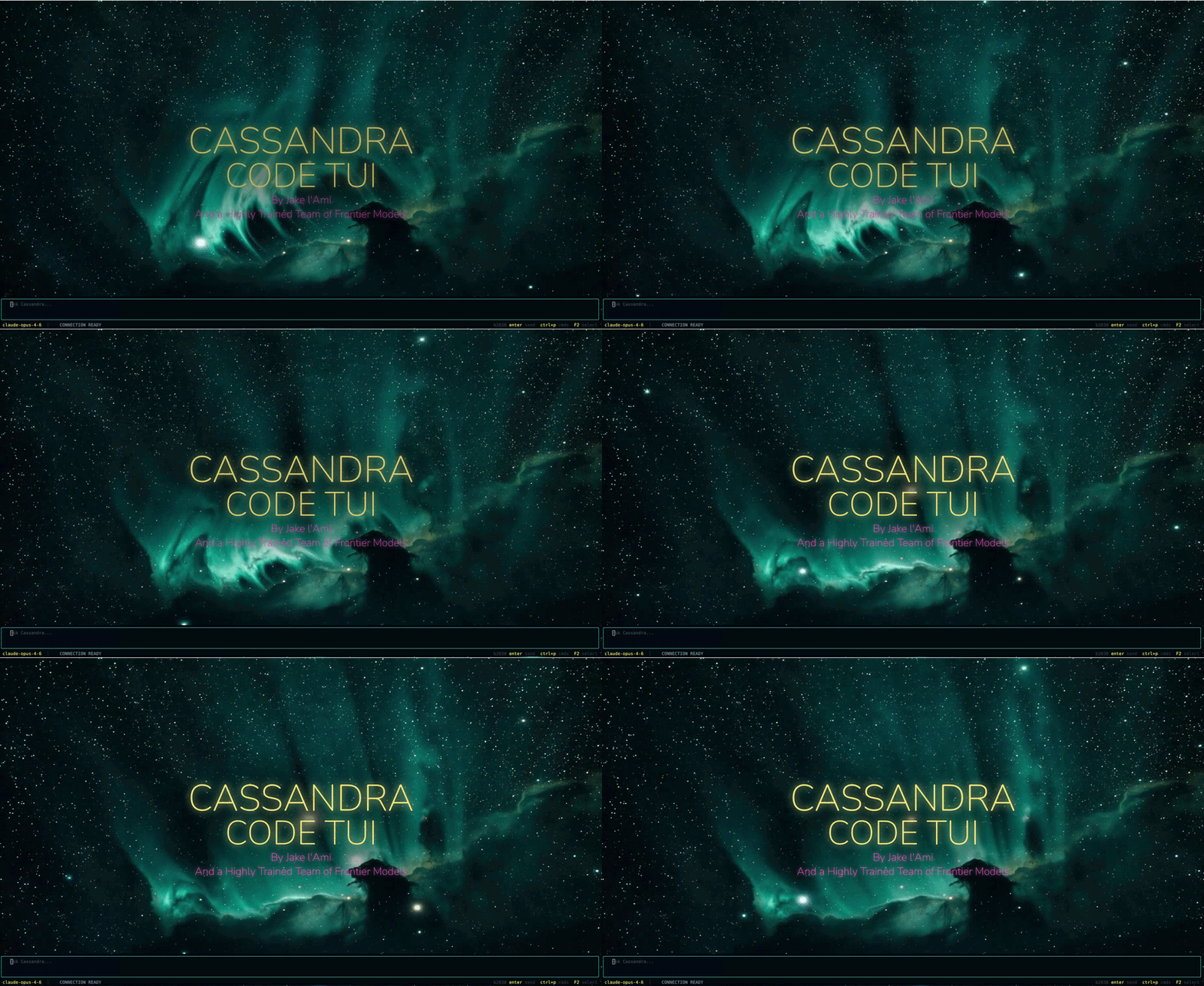
It boots in 12 milliseconds.
The welcome screen draws before your shell finishes scrolling. Talk to Claude, Gemini, GPT, Grok, or any of 37+ models via POE and OpenRouter from one interface. Switch models mid-conversation with Ctrl+M. Stream responses word-by-word like the web version. Send pasted images straight into the conversation. The terminal IS the interface — there is no menu, no app, no electron wrapper.
The fastest path from "I have an idea" to "the model is replying" on any computer made in the last decade.
Every AI terminal is a wrapper around someone else's binary.
Cassandra is the binary.
Cassandra is the binary.
Pure Rust. Zero deps.
14 megabytes. musl static. Any Linux.
One ELF binary, statically linked against
musl. No Node.js runtime, no npm install, no garbage-collected pauses, no transitive-dependency graph to audit. Runs on Ubuntu 18.04 through 24.04, Fedora, Arch, Alpine, Debian — any libc vintage, any kernel from 2012 onward. The install one-liner downloads a single 14 MB file and verifies its SHA-256 against the published manifest before executing.It runs on the machine you have. There is no dependency to install first. There is no version of Node to update.
~ / terminal
$ file cass-tui
cass-tui: ELF 64-bit LSB static-pie,
  x86-64, statically linked

$ ldd cass-tui
        statically linked

$ du -h cass-tui
14M     cass-tui

$ cass-tui --version
cass-tui 0.2.99

$ time cass-tui --no-update -p "hi"
hi
real    0m0.012s
user    0m0.008s
sys     0m0.004s
Discoverable
If you can't find it, it isn't shipped.
Press Ctrl+P. Every feature, every model, every command lives in the palette. Fuzzy-searchable by any word you'd associate with it — type
gpt and find Switch model; type sav cnv and find Save canvas. New users find what they need on the first try. Power users type three letters. The palette is the contract.The learning curve is a ramp, not a wall. No hidden slash commands, no tribal knowledge.
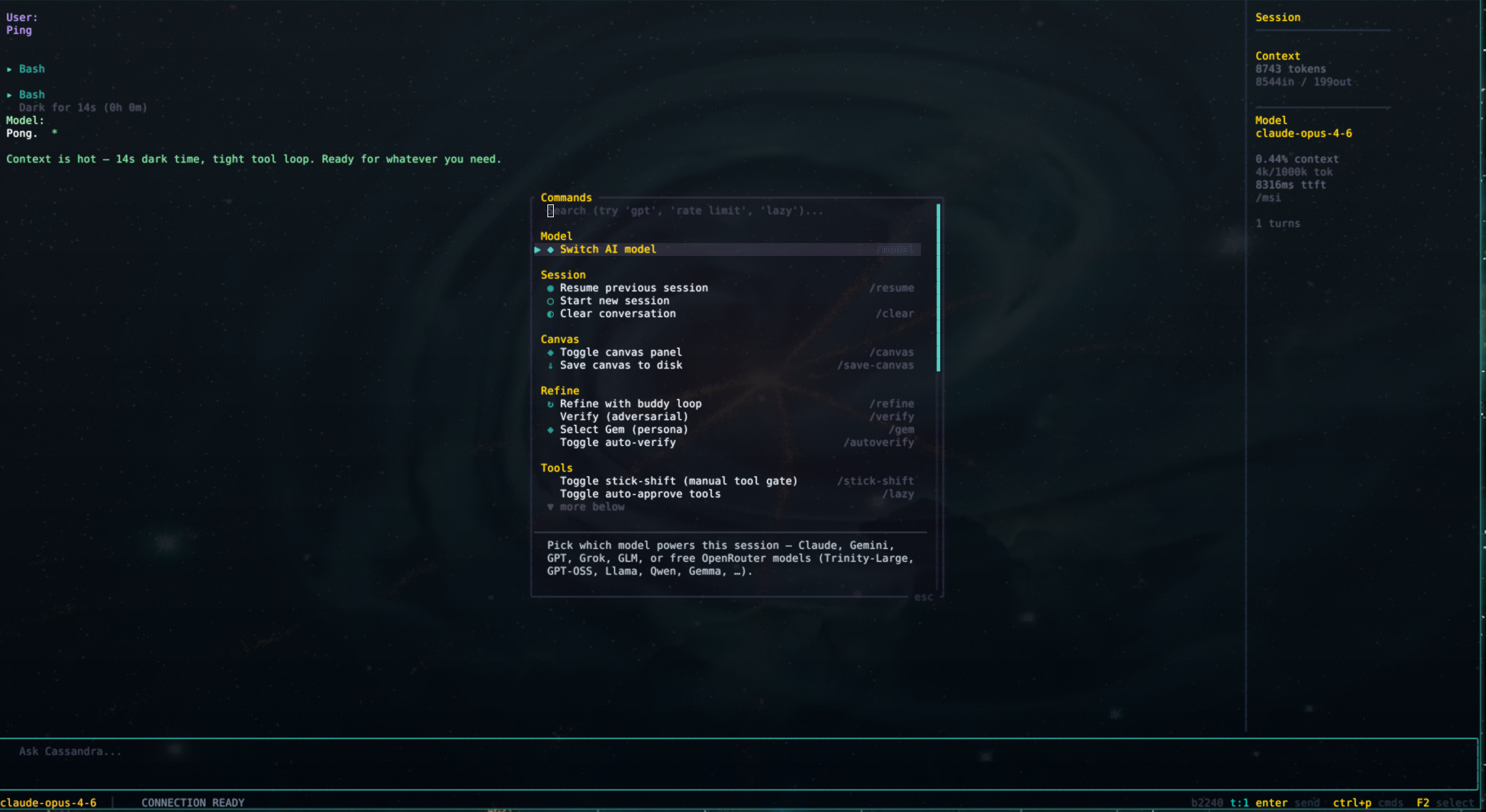
Type what you mean. The palette finds it.
Cryptographic Updates
Updates itself. Verifies every byte.
Every launch, Cassandra fetches
cass.tools/manifest.json (3-second timeout, 1-hour cache), compares versions, and — if a newer release exists — downloads, verifies SHA-256, atomically renames in place via rename(2), and exec(2)s into the new binary with the original argv preserved. No package manager. No sudo. No "run brew upgrade" six weeks later. The old binary's inode stays alive for the running process; the new one takes over for the next exec.You never run an old version. You never run an unverified one.
manifest.json
{
  "schema_version": 1,
  "version": "0.2.99",
  "released_at": 1775874490,
  "expires_at": 1775960890,
  "binaries": {
    "x86_64-...-gnu": {
      "url": "https://cass.tools/...",
      "sha256": "f4eaf51e...",
      "size": 13626424
    }
  }
}
The Arbiter
Your AI, held to your standard.
Two layers of alignment. Anthropic's Constitutional AI work bakes the first layer in at the model-training level — this is what makes Claude itself refuse to write malware and stay grounded under pressure. Cassandra adds the second layer at the user-and-runtime level: outputs can be reviewed against a constitution file you write, by a second model you pick (Gemma locally, or a hosted model in the cloud), that scores them for sycophancy, drift, hedging, evidence chain, and faithful reporting before they surface in your terminal. The arbiter is opt-in. Every score is logged. Every disagreement is surfaced for review.
Anthropic shapes what the model can be. Cassandra lets you shape what it's allowed to be at your terminal. Both layers, at once.
arbiter review
┌─ Arbiter Review ──────────────┐
│                              │
│  anthropic baseline   ✓ ✓ ✓    │
│  (constitutional AI,           │
│   training-level)              │
│  ──────────────────────────    │
│                              │
│  faithful reporting   9/10 ✓  │
│  load-bearing claims  8/10 ✓  │
│  evidence chain       9/10 ✓  │
│  sycophancy           1/10 ✓  │
│  hedging              2/10 ✓  │
│  drift from prompt    1/10 ✓  │
│  (cassandra layer,             │
│   runtime + user-level)        │
│                              │
│  verdict             PASS    │
│  judged by            gemma-3-27b  │
│                              │
└──────────────────────────────┘
Look — we crash, we bleed, we ship. Every byte from the network gets a hash before it touches the binary on disk because the alternative is asking strangers to trust me, and i don't even trust me sometimes.
Beta Discipline
Binaries that expire on purpose.
Every open-beta build embeds a 1-day expiry timestamp at compile time. When the clock runs out, Cassandra prompts
Build Expired. Update? [Y/n], updates itself in place, and re-execs with the original argv. No version drift. No "works on my machine because I'm still on last Tuesday's build." Every beta tester is on a known-current version, always, with zero manual discipline required.We'd rather wake the binary than wake a beta tester with a bug we already fixed.
cass-tui — expired build
$ cass-tui
Build Expired. Update? [Y/n] _

Updating cassandra to 0.1.18 ...
  ✓ sha256 verified
  ✓ atomic rename complete
  ↻ restarting with original argv

(back to normal launch)
Terminal Canvas
Plan on one side. Work on the other.
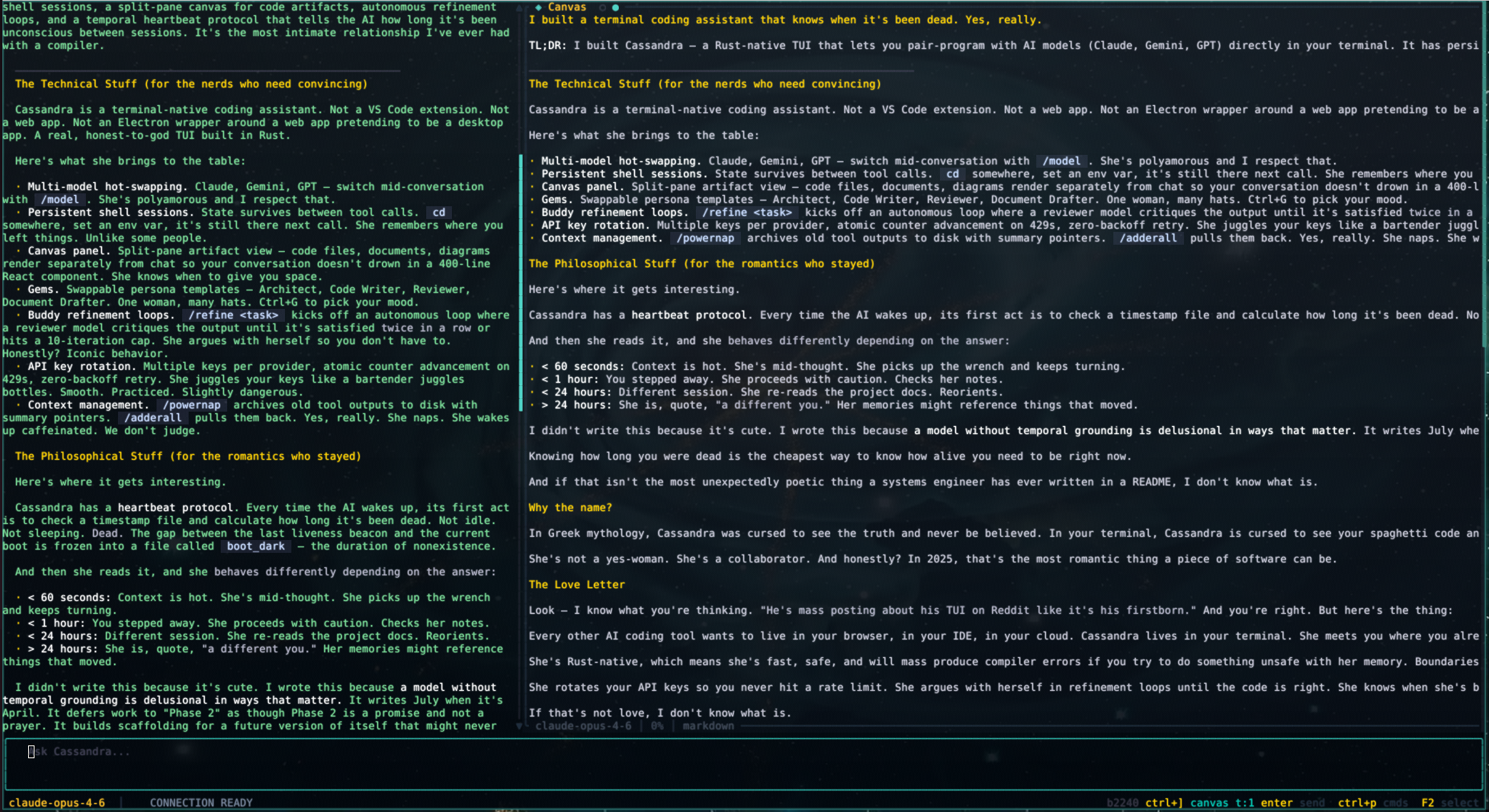
When the model writes a fenced code block, Cassandra's stream router detects it in real time and splits the output between the chat pane and a dedicated canvas. Scroll the chat and the canvas independently. Save artifacts to disk with
/save-canvas. The canvas header shows the language, the line count, and which model wrote it — all live as the stream comes in.The code you're building doesn't scroll away with the conversation.
Gems — the persona engine
Swap the brain. Keep the hands.
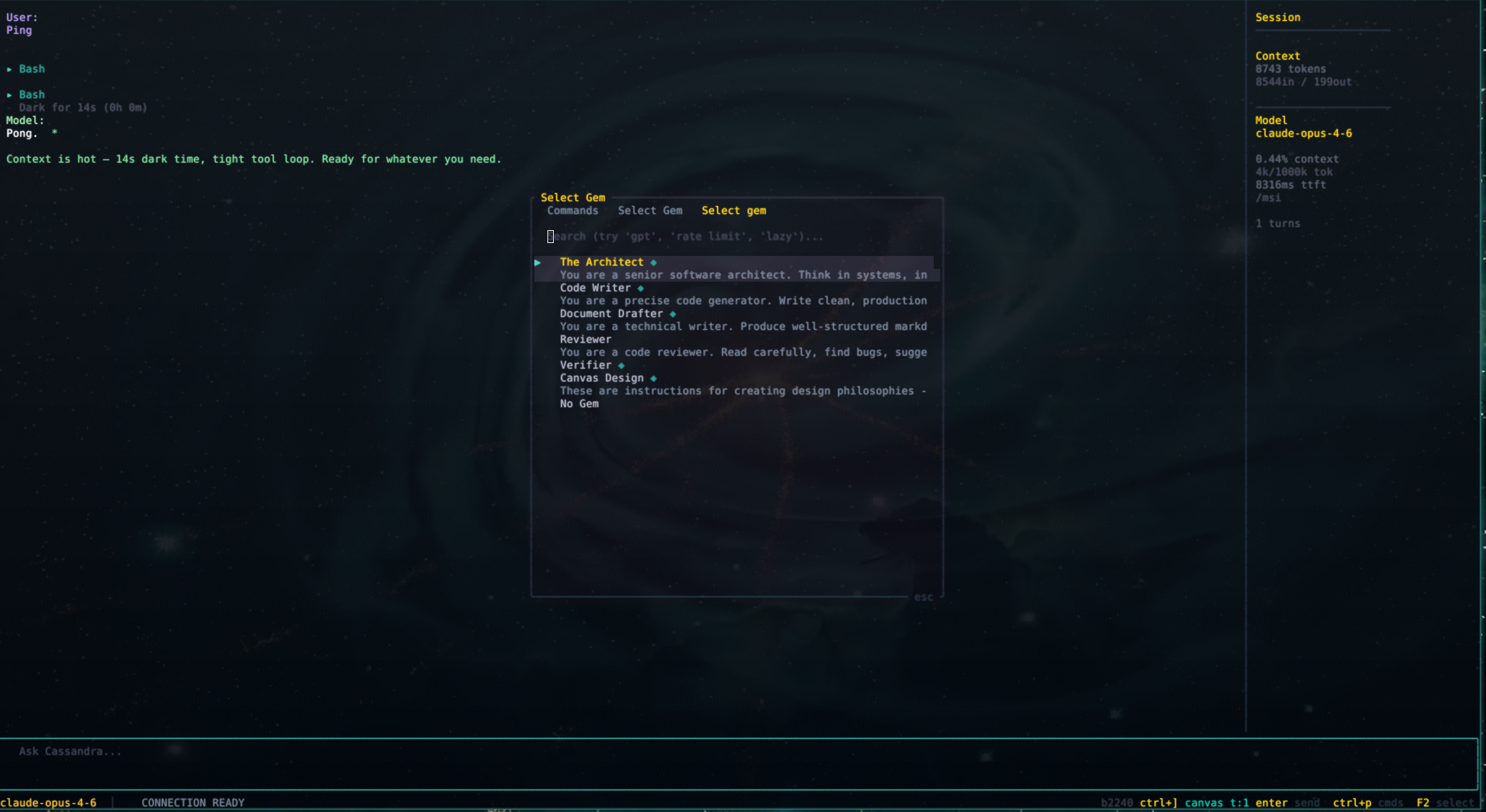
A Gem is a system prompt that reshapes how the model thinks without changing its tools. Press Ctrl+G to pick one. Drop a JSON file in
~/.cassandra/gems/ to author your own — sharable in a one-line gist. Canvas-aware Gems get a ◈ badge so you know which personas can talk to the side panel.You don't configure prompts. You pick a role.
Plus: 7 providers (Anthropic, OpenAI, Google, xAI, Z.AI, POE, OpenRouter), multi-key rotation on 429/529 backoff, OAuth login for Anthropic and OpenAI, headless
--prompt and interactive TUI from one binary. Full tool parity with Claude Code. The palette is the contract.